
 Quicklinks▼
 Careers
 Citrix Storefront
 Contact
 Departments & Centers
 Donate
 Emergency Preparedness
 Find Employees
 LSU Health New Orleans
 Intranet
 Moodle
 myLSUHSC
 Office 365
 Office 365 Mail
 Patient Care
 Remote VPN
 Self Service


 LSU Health New Orleans

Sonia Gasparini, Ph.D.
Sonia Gasparini, Ph.D.
Professor of Neuroscience, Cell Biology and Anatomy
Professor of Neuroscience, Cell Biology and Anatomy
Neuroscience Center of Excellence
School of Medicine, LSU Health
2020 Gravier Street, New Orleans, LA 70112
(504) 599-0869
sgaspa1@lsuhsc.edu
Bio
Degrees
1994-1998: PhD, University of Milano, Italy
1989-1994: BSc, University of Milano, Italy
Positions
2020-present: Professor of Cell Biology and Anatomy and Neuroscience, Neuroscience Center of Excellence, LSUHSC
2014-present: Associate Professor of Cell Biology and Anatomy and Neuroscience, Neuroscience Center of Excellence, LSUHSC
2010-2014: Assistant Professor of Cell Biology and Anatomy and Neuroscience, Neuroscience Center of Excellence, LSUHSC
2005-2010: Assistant Professor - Research, Neuroscience Center of Excellence, LSUHSC
2001-2004: Postdoctoral fellow, Neuroscience Center of Excellence, LSUHSC, New Orleans, LA
1998-2000: Postdoctoral fellow, Biophysics Sector, SISSA-ISAS, Trieste Italy
Awards/Recognitions/Lectures
2023: Guest Lecturer at the Cold Spring Harbor Laboratory Course: "Ion Channels in Synaptic Transmission and Neural Circuits"
2022: Guest Lecturer at the Cold Spring Harbor Laboratory Course: "Ion Channels in Synaptic Transmission and Neural Circuits"
2020: Guest Lecturer at the Cold Spring Harbor Laboratory Course: "Ion Channels in Synaptic Transmission and Neural Circuits"
2019: Guest Lecturer at the Cold Spring Harbor Laboratory Course: "Ion Channels in Synaptic Transmission and Neural Circuits"
2018: Guest Lecturer at the Cold Spring Harbor Laboratory Course: "Ion Channels in Synaptic Transmission and Neural Circuits"
2017: Guest Lecturer at the Cold Spring Harbor Laboratory Course: "Ion Channels in Synaptic Transmission and Neural Circuits"
2015: Jack Hines III Memorial Award for Outstanding Service to the LSUHSC School of Graduate Studies
2015: LSU School of Medicine Faculty Assembly Outstanding Service to the Community award
2011: LSU School of Medicine Alumni Excellence Award
2009: Invited speaker at the Gordon Research Conference
“Dendrites: Molecules, Structure and Function”, Il Ciocco, Italy
2008: Dart Neuroscience Scholars Program in Learning
and Memory Award (PI)
2007: Albert and Ellen Grass Faculty Program Award (PI)
2005: Albert and Ellen Grass Faculty Program Award (PI)
2002-2004: NARSAD Young Investigator Award
2002: Ochsner Clinic Foundation Research Award
Research Interests
Research Interests and Goals:
Information processing and memory formation. Dendritic excitability and plasticity: synaptic transmission and voltage-dependent channel activity in hippocampal and entorhinal neurons
Research Interest Statement:
Dendritic integration in the entorhinal cortex (EC)
The enthorhinal cortex is a key relay structure for the flow of information between the hippocampus and the neocortex. Not only does it act as a primary interface, it also plays a critical role in the computation of multi-sensory and cognitive modalities. The latter function is clearly supported by the direct involvement of the entorhinal cortex in neurodegenerative and psychiatric disorders such as Alzheimer’s disease, epilepsy and schizophrenia. In particular, layer V neurons, being the main target of processed outputs leaving the hippocampal formation and sending their axons to cortical regions, play an important role in the consolidation and replay of memories, which involve hippocampal-neocortical communications.
To understand the function of EC layer V neurons, it is essential to understand how they integrate the inputs they receive to generate the output that is transferred to the neocortex; this complex process depends on the neuronal morphology and the density and properties of dendritic voltage-dependent channels. Despite their fundamental role in the consolidation and replay of memories, very little is known about the integrative features of these neurons.
By elucidating the mechanisms of dendritic integration in the entorhinal cortex, these studies will increase our knowledge of memory processing. Relating pathological effects to electrophysiological properties of neuronal compartments that have not been fully explored, such as dendrites, may shed light on basic neuronal properties and provide insights for novel points of therapeutic intervention and disease prevention.
Current research projects:
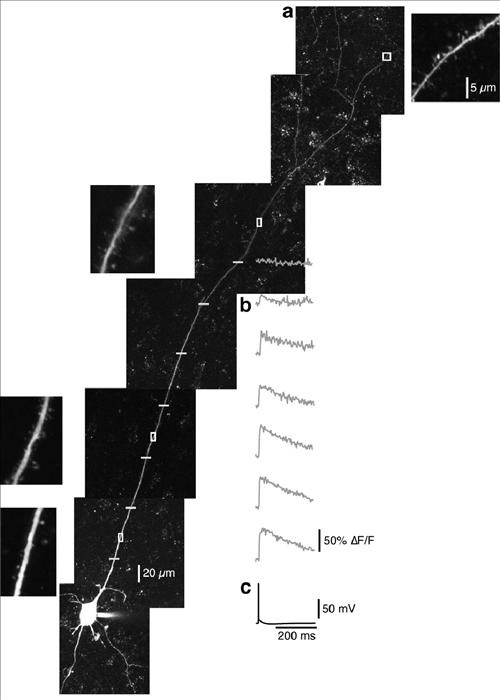
In our research, we employ electro-physiological techniques (dendritic and somatic patch clamp recordings) coupled with electrical stimulation and multi-photon imaging and uncaging of caged neurotransmitters (such as glutamate) on brain slices. Using these techniques, we are currently studying the properties of the synaptic inputs and how they are integrated with voltage-dependent currents, the initiation of active processes in the dendrites (i.e. dendritic spikes) and their impact on the somatic output in hippocampal CA1 neurons and neurons of the deep layers of the entorhinal cortex. The ultimate goal is to relate the input-output features of these neurons to the different behavioral states and memory formation.
Teaching Activities
2023-present: Co-director of the Molecular Biology course (INTER 121)
2016-present: Co-director of the Cell Biology course (INTER 122)
2015-2016: Co-director of the Cell and Molecular Biology course (INTER 121)
2010-2017: Co-director of the Introduction to Research Resources course (INTER 101)
2016-present: Lecturer in the Cell Biology course (INTER 122), topic Membrane Transport and Electrical Properties of Membranes
2015-present: Lecturer in the Cell Biology course (INTER 122), topic Analyzing and Visualizing Cell Structures
2010-2015: Lecturer in the Cell and Molecular Biology course (INTER 121), topic Membrane Properties and Electrical Potential
2008-present: Lecturer in the Synaptic Organization of the Brain course (ANAT 264), topic Hippocampus
2007-present: Lecturer in the Biological Systems B course (INTER 132), topic Passive and Active Properties of Dendrites and Axons
2006-present: Lecturer in the Investigative Neuroscience course (NEURO 203), topic Membrane Potential and Action Potential
2006-present: Lecturer in the Molecular Neurobiology course (NEURO 250), topic Structure and Function of Voltage-Gated Ion Channels
Committees & Administrative Responsibilities
2015-2021: Center for Inter-Professional Education and Collaborative Practice (CIPECP), School of Graduate Studies Liaison
Selected Publications
Selected Peer-Reviewed Papers:
Combe C. L., Upchurch C. M., Canavier C. C., Gasparini S. (2023). Cholinergic modulation shifts the response of CA1 pyramidal cells to depolarizing ramps via TRPM4 channels with potential implications for place field firing. Elife 12: e84387
Edwards S., Ferguson T. F., Gasparini S., Mercante D. E., Molina P. E. & Gunaldo T. P. (2023). Interprofessional education as a potential foundation for future team-based prevention of alcohol use disorder. BMC Med Educ. 23(1):126. doi: 10.1186/s12909-023-04100-y
Upchurch C. M., Combe C. L., Knowlton C, Gasparini, S.* &Canavier, C. C.* (2022). Long-Term Inactivation of Sodium Channels as a Mechanism of Adaptation in CA1 Pyramidal Neurons. J. Neurosci. 42 (18) 3768-3782 *These authors jointly supervised this project
Combe C. L., Gasparini S. (2021). Ih from synapses to networks: HCN channel functions and modulation in neurons. Prog. Biophys. Mol. Biol. 166C: 119-132
Brisolara, K. F., Gasparini, S., Davis, A. H., Sanne, S., Andrieu, S. C., James, J., Mercante, D. E., De Carvalho, R. B., Patel Gunaldo, T. (2019). Supporting health system transformation through an interprofessional education experience focused on population health. J. Interprof. Care 33: 125-128
Combe, C. L., Canavier, C. C. & Gasparini, S. (2018). Intrinsic mechanisms of frequency selectivity in the proximal dendrites of CA1 pyramidal neurons. J. Neurosci. 38: 8110-8127
Highlighted in “This Week in the Journal” (Acetylcholine, via SK Channels, Regulates CA3–CA1 Coupling)
Lin, E. C., Combe C. L. and Gasparini, S. (2017). Differential contribution of Ca2+-dependent mechanisms to hyperexcitability in layer V neurons of the medial entorhinal cortex. Front. Cell. Neurosci.11, 182
Savtchouk, I., Sun, L, Bender, C. L., Yang, Q., Szabo, G., Gasparini, S. and Liu, S. J. (2016). Topological regulation of synaptic AMPA receptor expression by the RBA-binding protein CPEB3. Cell Reports 17: 86-103
Wang, S., Musharoff, M., Canavier, C. C. & Gasparini, S. (2013). Hippocampal CA1 pyramidal neurons exhibit Type 1 phase response curves and Type 1 excitability. J. Neurophysiol. 109:2757-2766
Medinilla, V., Johnson, O. & Gasparini, S. (2013). Features of proximal and distal excitatory synaptic inputs to layer V neurons of the rat medial entorhinal cortex. J Physiol. 591:169-183
Gasparini, S. (2011). Distance- and activity-dependent modulation of spike back-propagation in layer V pyramidal neurons of the medial entorhinal cortex. J. Neurophysiol. 105: 1372-1379
Ascoli, G.*, Gasparini, S.*, Medinilla, V. & Migliore, M. (2010). Local control of post-inhibitory rebound spiking in CA1 pyramidal neuron dendrites. J. Neurosci. 30:6434-6442.*These authors contributed equally
Gasparini, S., Losonczy, A., Chen, X., Johnston, D. & Magee J. C. (2007). Associative pairing enhances action potential back-propagation in radial oblique branches of CA1 pyramidal neurons. J Physiol. 580:787-800
Gasparini S. & Magee, J. C. (2006). State-dependent dendritic computation in hippocampal CA1 pyramidal neurons. J. Neurosci. 26:2088-2100
Gasparini, S., Migliore, M. & Magee, J. C. (2004). On the initiation and propagation of dendritic spikes in CA1 pyramidal neurons. J. Neurosci. 24: 11046-11056
Book Chapters:
Gasparini S. & Migliore M (2022). Action Potential Back-Propagation. In: Encyclopedia of Computational Neuroscience, second edition, pp. 151-156, edited by D. Jaeger and R. Jung. Springer New York. https://doi.org/10.1007/978-1-0716-1006-0_123
Gasparini, S. & Palmer, L. M. (2016). Dendritic patching and imaging in hippocampal and cortical slices. In: Advanced Patch Clamp Analysis for Neuroscientists, Neuromethods Vol. 113, pp. 97-122, edited by A. Korngreen. Springer New York.
Gasparini S. & Migliore M (2015). Action Potential Back-Propagation. In: Encyclopedia of Computational Neuroscience, pp 133-137, edited by D. Jaeger and R. Jung. Springer New York. DOI: 10.1007/SpringerReference_348188
Additional Info
Funding:
“CRCNS: Cholinergic contribution to hippocampal information processing”
Principal Investigators (multi-PI award): Carmen C. Canavier, PhD & Sonia Gasparini, PhD
Agency: NIMH/NIH (MH115832). Period: 8/15/2017 – 5/31/2023