
Treatment - Epilepsy Surgery
When medicines fail
If two anticonvulsants fail to control seizures, the chances that adding another drug will bring seizures under control are four in a hundred (4%). (NEJM)
What is the role of surgery in controlling epileptic seizures?
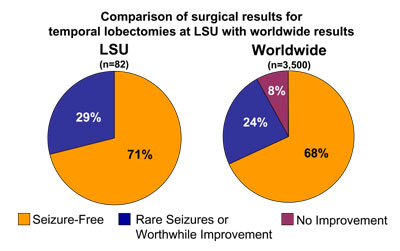
Surgery can cure the most common form of seizures (temporal lobe) in up to seven in 10 people (70%). For example, Dr. Michael Carey, retired from Neurosurgery at the LSUHSC-NO Epilepsy Center, has performed more than 150 surgical procedures for epilepsy with the following results temporal lobe surgery.
LSU Epilepsy Surgery Outcomes
Temporal Lobectomies: 1994-2004
Outcomes
|
Temporal Lobectomies |
| Seizure-Free | 71% |
| Rare Seizures | 19% |
| Seizures Improved | 10% |
Comments from patients, treated at LSUHSC-NO, who had seizure surgery
I can't begin to tell you . . . how much you have changed my life . . . since I've been seizure free.
S. M., Dec. 2002Can you believe it's been 4 years? Thank you for setting me free.
N. A., Aug. 1999Thank you for all that you have done for me and bringing hope to the future.
K. C., 2003You have dramatically improved my life.
E. C.
Before considering any operation, a number of tests need to be performed by the surgeon. These tests are given by the Center's neurologists, neuropsychologists, and radiologists. An epilepsy surgery evaluation typically includes the following tests: an MRI scan (to get a picture of the brain), epilepsy monitoring with a simultaneous EEG and video recording (to be sure of the seizure type), a PET scan (to check brain metabolism), neuropsychological testing (to see how the brain is working), and the WADA test (to localize speech and memory). Sometimes another test can be helpful in locating the seizure area by determining blood flow throughout the brain (the SPECT scan). If seizure localization is not satisfactory by these means sometimes it is necessary to put sterile, EEG electrodes in and on the brain by surgical “burr holes”and then do more EEG monitoring in the epilepsy unit.
Different surgical procedures are done for different types of epilepsy. Since the most common brain abnormality causing seizures is in the temporal lobe, temporal lobectomy is the most common surgical procedure performed. Sometimes other portions of the brain can be removed (topectomy) or modified (subpial transection) without causing harm. Our Center can also use the gamma knife. If tests indicate that a direct brain operation is not possible a vagus nerve stimulator (VNS) is another option, VNS reduces seizures by about 50% in half of patients who use it. About 10 to 15% experience a greater reduction of seizures.
If you would like to consider surgery for your epilepsy, call the LSU Health Multispecialty Clinic at (504) 412-1517 and schedule an appointment with Dr. Piotr Olejniczak.