
Contact Us
Undergraduate Medical Education
- Robin English, MD
Associate Dean,
Undergraduate Education - rengli@lsuhsc.edu
- 504-568-4620
- 504-599-1453
- 2020 Gravier Street, Suite 657
New Orleans, LA 70112
Undergraduate Medical Education
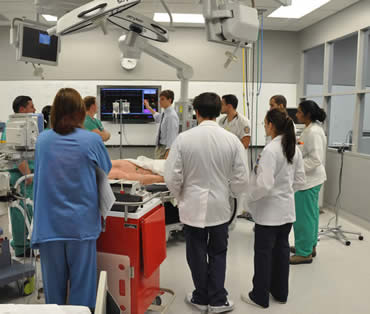
The Louisiana State University School of Medicine in New Orleans (LSUSOM-NO) medical education program extends over a four-year period and leads to the M.D. degree. The first three years of the curriculum are managed centrally by the Office of Undergraduate Medical Education (UME) with input from faculty and students across all four years. Curriculum management consists of several faculty and student committees with defined roles and responsibilities. The fourth year of the curriculum is managed centrally by the Office of Student Affairs due to the student-focused flexibility of that period. The most recent major curriculum revision was implemented in the academic year 2015-2016, but ongoing minor revisions occur regularly based on feedback from faculty and students. Our principal aim for the medical education program is to develop competent, compassionate physicians who will excel in their graduate medical education programs and serve our communities well.
The medical curriculum includes a 21-month preclerkship phase, which includes discipline-based courses, organ system-based courses, and longitudinal courses that focus on clinical and communication skills. Instruction in this phase occurs largely in the classroom and utilizes both large-group and small-group formats, including lectures, Team Based Learning exercises, small group discussions, and clinical skills laboratory sessions. The primary goal of the preclerkship phase is to provide the students with a strong foundational understanding of biomedical principles and clinical skills so that they can effectively build on their knowledge in their clinical rotations and pass the USMLE Step 1 examination.
After successful completion of the preclerkship phase, students enter the clerkship phase which consists of a brief Clerkship Preparation course, followed by seven core clinical clerkships and an elective for career planning. Students may complete their clerkship phase at one of our regional campuses (Baton Rouge or Lafayette) or may be based out of the primary campus in New Orleans. Clinical sites include multiple area hospitals and clinics and provide our students with a diverse patient population with a wide variety of pathologic conditions. Students take the USMLE Step 2 examination after their third year and must pass it in order to graduate.
Senior students complete two acting internships and one course that focuses on clinical emergencies and critical care settings. A final brief course provides students with additional information to prepare them for their upcoming residencies, such as financial planning, contracts, and clinical pearls. The remainder of the year consists of electives that students select to best prepare them for their chosen specialty and time to participate in residency interviews and pursue areas of interest.
In summary, the medical education program prepares students to become physicians who consistently display attributes befitting to the profession of medicine and who engage in continuous learning for the benefit of their patients. Our students are dedicated and enthusiastic learners who are guided through their educational program by devoted, knowledgeable, and engaged faculty members.
Robin English, MD
Associate Dean for Undergraduate Medical Education
Catherine "Cacky" Hebert, MD
Assistant Dean for Undergraduate Medical Education
Ross McCarron, MD
Co-Director of Clinical Science Curriculum
Jessica Patrick, MD
Co-Director of Clinical Science Curriculum
Andrew Hollenbach, PhD
Co-Director of Basic Science Curriculum
Joy Sturtevant, PhD
Co-Director of Basic Science Curriculum
Alisa Roy, M.Ed.
Coordinator, Undergraduate Medical Education
Herman Williams
Coordinator, Undergraduate Medical Education
Juayonna Spencer
Coordinator, Undergraduate Medical Education
Office of Undergraduate Medical Education
LSUHSC, School of Medicine
2020 Gravier St., Suite 657
New Orleans, LA 70112
504-568-4620 (Phone)
504-599-1453 (Fax)