
 Quicklinks▼
 Careers
 Citrix Storefront
 Contact
 Departments & Centers
 Donate
 Emergency Preparedness
 Find Employees
 LSU Health New Orleans
 Intranet
 Moodle
 myLSUHSC
 Office 365
 Office 365 Mail
 Patient Care
 Remote VPN
 Self Service


 LSU Health New Orleans

Christian Sheline, Ph.D.
Christian Sheline, Ph.D.
Associate Professor, Ophthalmology and Neuroscience
Associate Professor, Ophthalmology and Neuroscience
2020 Gravier Street, Suite D
New Orleans, LA 70112
Phone: (504) 599-0880
Fax: (504) 568-5801
csheli@lsuhsc.edu
Degrees
1996-1998: Postdoc, Washington University, St. Louis, MO
1989-1995: Postdoc, The Salk Institute, San Diego, CA
1984-1989: Ph.D., University of California, Los Angeles, CA
1979-1983: B.A., Dartmouth College, Hanover, NH
Bio
Awards/Recognitions/Lectures
2007 to 2008: Alzheimer’s Disease Research Center small pilot grant
2006 to 2011: NIDDK R01 grant 073446
2002 to 2007: NINDS R01 grant 30337
1996-97: NIH postdoctoral training grant
1993-94: NIH postdoctoral training grant
1989 to 1996: Member California Task force against AIDS
1990-92: California Universitywide Task force on AIDS postdoctoral grant 525247.
1/86 to 1/89: NIH predoctoral training grant in Genetics GM07104
1988: Special Faculty Award, UCLA Department of Biology.
My lab studies the death induced by excess zinc which occurs after injuries and pathophysiologic conditions in neurons and beta-cells. Primary cortical neuronal cultures exposed to Zn2+ had reduced levels of ATP, and NAD+, while glycolytic intermediates, and lactate levels increased. Measures which restored the NAD+ levels, such as exogenous addition of NAD+, nicotinamide, or pyruvate prevented zinc-induced death, and a measure which increased the loss of NAD+ (3-AP) potentiated death. The sirtuin pathway is involved because the inhibitor, sirtinol, attenuated injury, and the activator, resveratrol, potentiated injury. Further implicating the role of NAD+ levels, neurons from Wlds mice (which overexpress an NAD+ synthetic enzyme) were resistant to Zn2+ toxicity. These in vitro systems serve as a model of ischemic neurodegeneration in vivo. We and others have demonstrated that nicotinamide, pyruvate, or CaEDTA attenuated neuronal death induced by retinal ischemia, global ischemia, focal ischemia, hypoglycemia, seizures, and head trauma in vivo. This research was funded by an R01 grant from NINDS. Intracellular release of Zn2+, loss of NAD+ levels, and the sirtuin pathway are also involved in reactive oxygen species (ROS) mediated neuronal injuries including serum deprivation (in vitro) and target deprivation (in vivo). Pre-loading neuronal cultures with physiologic levels of Zn2+ potentiated ROS and serum deprivation mediated death, whereas Zn2+ chelation attenuated death. Neuroprotection was similarly afforded by compounds which restored NAD+. Using the in vivo model of lateral geniculate nucleus target deprivation induced by visual cortex ablation (VCA), it was shown that Zn2+ toxicity likely plays a role. We have now shown that i.p. injection of pyruvate or nicotinamide, or direct lesion application of CaEDTA or NAD+ reduced LGN neuronal death 7 days later. Furthermore, Wlds mice demonstrated greatly reduced LGN neuronal death after VCA. We will investigate the role of these Zn2+-mediated mechanisms after global and retinal ischemias, and VCA using mouse genetic models to manipulate Zn2+ and NAD+ levels. R01 grant applications to fund these studies are pending with NINDS and NEI.
Zn2+ release may also be required for adult hippocampal neurogenesis, and these studies are ongoing.
These studies provided good targets to test in another model of Zn2+ mediated toxicity. Zn2+ toxicity also plays a role in the secondary death of beta-cells in pancreatic islets of diabetic mice. Nicotinamide, CaEDTA, and pyruvate attenuated beta-cell death and diabetic incidence in acute streptozotocin (STZ) induced diabetes. The non-obese diabetic mouse (NOD) develops diabetes through an auto-immune mediated mechanism and is therefore more physiologic. We have demonstrated that islets of aged NOD mice demonstrated increased punctate Zn2+ staining upon lymphocyte infiltration. Furthermore, pyruvate treatment of these animals reduced the loss of beta-cell mass, diabetic incidence, and mortality. Pyruvate, nicotinamide, NAD+, and sirtinol also attenuated the death of beta-cells induced by Zn2+, STZ, and cytokines with partial confirmation in isolated islets. Furthermore, beta-cell lines manipulated to increase or decrease expression of the most abundant sirtuin family member (SIRT-1) showed that SIRT-1 expression determined the level of toxicity of Zn2+, STZ, and cytokines in these beta-cells. These studies are funded by an R01 from NIDDK. Zn2+ dyshomeostasis through the beta-cell specific Zn2+ transporter 8 has been implicated in type-1 and type-2 diabetes in humans. A single nucleotide polymorphism mutation (R325W) in the beta-cell specific Zn2+ transporter, ZnT8, has been linked to reduced susceptibility for type-2 diabetes and shown to reduce Zn2+ uptake into beta-cells. ZnT8 was also recently shown to be a major autoantigen in type-1 diabetes. We have made founder transgenic mice which overexpress human ZnT8 WT and R325W in beta-cells, and are currently characterizing them for germ-line transmission and expression. These animals may provide new models for the study of type-1 and type-2 diabetes, and we will test their blood glucose and sensitivity to STZ, a high-fat diet, cytokines, and backcross to NOD, ob/ob, and db/db mouse models of diabetes. An R01 grant application to fund these studies is pending with NIDDK.
Research Interests
Neurotoxicity and Neuroprotection in Disease States
Molecular mechanisms of the requirement for zinc in tumor proliferation and neurogenesis, zinc neurotoxicity in injuries and neurodegeneration, and zinc toxicity in b-cells leading to diabetes.
Current Research
Zn2+ neurotoxicity: role of NAD+ loss and glycolytic inhibition in vitro and in vivo.
Zn2+ neurotoxicity has been shown to be involved in neuronal injury from global, focal, and retinal ischemias as well as head trauma, seizures, neuronal target deprivation, and hypoglycemia. Exogenous Zn2+ or Zn2+ released intracellularly because of oxidant conditions appear to have similar mechanisms of toxicity. NAD+ is lost resulting in glycolytic inhibition, and compounds or genotypes which can attenuate the NAD+ loss also attenuate glycolytic inhibition and neuronal death. Exogenous addition of NAD+ restores intracellular NAD+ as do, the conversion of pyruvate to lactate, and the synthesis of NAD+ from nicotinamide by NMNAT1. The sirtuin family of NAD+ dependent protein deacetylases appear to be involved as activators potentiate, and inhibitors attenuate death. We use in vitro culture of primary neurons as well as in vivo models of global, focal, and retinal ischemias and a model of target deprivation to study these processes. Techniques used include molecular biology to manipulate individual pathways by viral or transgenic means, biochemical measurements, and pharmacologic development of therapeutics.
Requirement for Zn2+ during tumor cell proliferation or neurogenesis in vitro and in vivo.
Recent studies have demonstrated that tumor growth appears to be limited by the availability of Zn2+. This result may be linked to the observed requirement of Zn2+ availability for robust neurogenesis in the adult hippocampus. Different members of the ZIP family of transporters have been shown to be robustly over expressed in various tumors. Overexpressing ZIP’s or the availability of extra Zn2+ potentiates tumor growth whereas knocking down their expression or Zn2+ chelation attenuates tumor growth. A similar situation occurs in adult hippocampus and expression of the ZnT3 zinc transporter and the availability of Zn2+. We are studying tumor growth, ZIP knockdown, and Zn2+ chelation in vivo, and the mechanisms of this Zn2+ mediated affect in tumor growth as well as neurogenesis with particular attention on the kinase pathways shown to be activated by Zn2+ and those kinase pathways which are implicated in cell proliferation.
|Zn2+ plays a role during b-cell death in diabetes which is also caused by NAD+ loss in vitro and in vivo.
Zn2+ is highly abundant in the secretory vesicles of pancreatic b-cells both bound to insulin and free. We showed that Zn2+ chelation, reduced Zn2+ in the diet, and pyruvate or nicotinamide reduce b-cell death and diabetic incidence in animal models of type-1 diabetes. We also showed that restoration of NAD+ levels or sirtuin inhibition attenuated b -cell death in vitro. We use in vitro and in vivo models of diabetes together with molecular and transgenic techniques to modify NAD+ and Zn2+ levels, or the sirtuin pathway to determine the molecular mechanisms involved in b-cell death to develop novel therapeutics for diabetes.
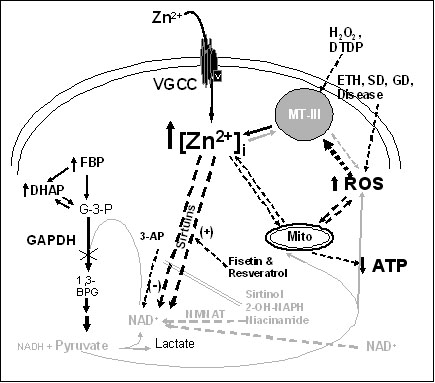
SD means serum deprivation, GD means glucose deprivation, ROS means reactive oxygen species, ETH means ethacrynic acid (ROS generator), DTDP means dithiodipyridine (a thiol oxidizing agent), VGCC means voltage gated Ca2+ channel, MT-III means metallothionein III, G-3-P, FBP, and DHAP are glycolytic intermediates preceding GAPDH (glyceraldehyde-3 phosphate dehydrogenase), 3-AP means 3-acetylpyridine (inactivates NAD+), sirtinol and 2-hydroxy naphthaldehyde are inhibitors, and fisetin and resveratrol are activators of the sirtuin pathway, Mito means mitchondria.
Selected Publications
Key Recent Papers
Sheline, C.T., Shi, C., Takata, T., Zhu, J., Xhang, W., Sheline, P.J., Cai, A.L: NOD Mice Demonstrated Toxic b-cell Zn2+ Staining; Pyruvate Attenuated b-Cell Death and Diabetic Incidence In Vivo. AJP, in submission (2009).
Sheline, C.T., Shi, C., Cai, A.L: Oxidative Neuronal Injuries and Target Deprivation: Role of Zn2+, NAD+, and the Sirtuin Pathway. Journal Neuroscience, in submission (2009).
Cai, A.L., Zipfel, G.J: Sheline, C.T: Zinc Neurotoxicity Is Dependent on Intracellular NAD+ Levels and the Sirtuin Pathway. European Journal of Neuroscience (2006) 24:2169-2176.
Sheline, C.T., Wei, L: Free Radical Mediated Toxicity May Be Caused By Inhibition of Mitochondrial Dehydrogenases In Vitro and In Vivo. Neurosci. (2006) 140:235-246.
Sheline, C.T., Choi, D.W: Copper-Mediated Toxicity May Be Caused By Inhibition of Mitochondrial Dehydrogenases In Vitro and In Vivo. Ann. Neuro. (2004) 55:645-53.
Sheline, C. T., Takata, T., Ying, H., Canzoniero, L.M.T., Yang, A., Yu, S.P., Choi, D.W: Potassium Attenuates Zinc-Induced Death of Cultured Cortical Astrocytes. Glia (2004) 46:18-27.
Sheline, C.T., Wang, H., Cai, A.-L., Dawson, V.L., Choi, D.W: Involvement of Poly-ADP Ribosyl Polymerase-1 in Fast But Not Slow Zinc Neurotoxicity. Eur. J. Neurosci (2003) 18:1402-9.
Sheline C.T., Ying H. S., Ling C.S., Canzoniero L.M.T., Choi D.W: Depolarization-Induced 65Zinc Influx into Cultured Cortical Neurons. Neurobiol. Dis.(2002) 10:41-53.
Sheline C.T., Behrens M.M., Choi D.W: Zinc-induced cortical neuronal death: contribution of energy failure attributable to loss of NAD(+) and inhibition of glycolysis. Journal of Neuroscience (2000) 20(9):3139-46.
Okamoto, H., Sheline, C.T., Corden, J.L., Jones, K.A., Peterlin, B.M: Trans-activation by human immunodeficiency virus tat protein requires the c-terminal domain of RNA polymerase II. PNAS (1996) 93(21):11575-9.
Sheline, C.T., Sheridan, P.L., Cannon, D., Voz, M.L., Pazin, M.J., Kadonaga, J.T., Jones K.A: Activation of the HIV-1 enhancer by the LEF-1 HMG protein on nucleosome-assembled DNA in vitro. Genes and Development (1995) 9(17):2090-104.
Selected Papers
Suh, S.W., Won, S.J., Hamby, A.M., Fan, Y., Sheline, C.T., Liu, J: Hypoglycemia induced neuronal death requires synaptic zinc., In Press, JCBFM., (2008).
Suh, S.W., Won, S.J., Hamby, A.M., Fan, Y., Sheline, C.T., Tamano, H., Takeda, H., Liu, J: Decreased brain zinc availability reduces hippocampal neurogenesis., J. Neurosci, in submission., (2008).
Additional Info
Funding
“Type-1 Diabetes: Zn2+ Potentiated b-Cell Death By Sirtuin-Mediated NAD+ Loss”
Agency: NIH/NIDDK-PI;
Type: R01 DK 073446-02;
Period: 8/01/06-4/30/11;
This R01 is aimed at understanding the role of Zn2+, NAD+ loss, and sirtuins in pancreatic b-cell loss using cell lines and in vivo models of type-1 diabetes.