
 Quicklinks▼
 Careers
 Citrix Storefront
 Contact
 Departments & Centers
 Donate
 Emergency Preparedness
 Find Employees
 LSU Health New Orleans
 Intranet
 Moodle
 myLSUHSC
 Office 365
 Office 365 Mail
 Patient Care
 Remote VPN
 Self Service


 LSU Health New Orleans

Ben Kelly, Ph.D.
Ben Kelly, Ph.D.
Associate Professor of
Microbiology, Immunology & Parasitology
Associate Professor of
Microbiology, Immunology & Parasitology
533 Bolivar St.
CSRB 346
New Orleans, LA 70112
bkell2@lsuhsc.edu
Degrees
B.Sc (Hons): Biochemistry, 1990
Ph.D.: Biochemistry & Molecular Parasitology, 1995
Imperial College, University of London, England
Bio
Dr. Kelly received his Ph.D. in 1995 from Imperial College, London,studying the molecular genetics of Leishmania with his mentor Dr. Deborah F. Smith. He subsequently carried out postdoctoral studies at the University of British Columbia, Canada with Dr. W.R. McMaster, studying the function and regulation of Leishmania surface proteinase genes using gene-targeting techniques. He followed these studies by joining the laboratory of Dr Richard M. Locksley at the University of California, San Francisco to study the importance of specific Leishmania antigens in determining protective versus non-protective T cell immunity. He subsequently joined the Sandler Center for Basic Research in Parasitic Diseases, directed by Dr. James H. McKerrow, where he initiated and directed a number of projects, including characterization of Leishmania serine proteinases and their role in pathogenesis.
Dr. Kelly joined the LSUHSC faculty in 2007 as an Assistant Professor in the Department of Microbiology, Immunology and Parasitology.
Research Interests
Dr. Kelly’s laboratory studies the biology of the protozoan pathogens, Leishmania and Trypanosoma cruzi. These parasites are transmitted via the bite of their insect vectors and are the etiologic agents of leishmaniasis and Chaga’s disease, respectively. Currently, there are no really effective treatments to combat these debilitating and often fatal diseases that have infected approximately 20 million people worldwide. Research in my laboratory focuses on understanding molecular functions of specific parasite proteins required for viability and virulence. We are especially interested in identifying important molecular functions unique to these parasites, as these may represent potential drug targets for better, low toxicity therapies against these diseases. Current major research projects in the lab include: (a) Determining how a molecular scaffolding protein, termed “LACK”, promotes expression of parasite genes important for virulence; (b) Identifying phosphorylation events important for parasite differentiation and virulence in collaboration with Juan Pizarro at Tulane.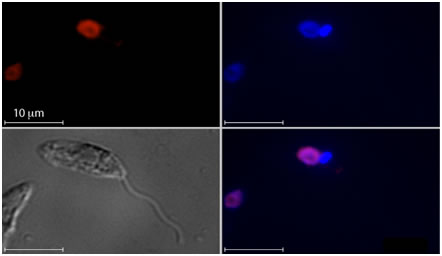
Leishmania expressing an AT-hook fused to GFP (red). DNA staining (blue) indicate the Leishmania nucleus and mitochondrion.
Teaching Activities
Medical Microbiology
Molecular Biology of Eukaryotic Pathogens
Fundamental and Advanced Immunology