
Youming Lu, Ph.D.,M.D.
Professor of Neurology and Neuroscience
Bollinger Professor of Alzheimer's Disease
LSUHSC Neuroscience Center of Excellence
2020 Gravier St, New Orleans, LA 70112
Tel: 504-599 0874
Fax: 504-568 580
Web Page
http://www.medschool.lsuhsc.edu/neuroscience/docs/Youming Lu revised 02-11-09.pdf
EDUCATION
1996-1999 PhD, University of Toronto, Canada
1993-1995 Postdoctoral Fellow, University of California, Irvine
1990-1993 Postdoctoral Fellow, Novartis, Basal, Switzerland
1987-1990 MS, China Pharmaceutical University, China
AWARDS AND RECOGNITION
2000-2006: New Investigator Award by Canada Institute for Health Research
2000-2005: Research Scholar Award by Alberta Heritage Foundation for Medical Research
1999-2001: Senior Research Fellowship by Canada Institute for Health Research
1997-1999: Tenable Merit Scholarship by University of Toronto
1997-1999: Laidlaw First Award by University of Toronto
1998-1999: Siminovitch Outstanding Research Award by University of Toronto.
1998: Joe A. Connolly Memorial Outstanding Research Award by University of Toronto
1996-1999: Doctoral Research Award by Medical Research Council of Canada
1991-1993: Postdoctoral Fellow by Ciba Foundation, Switzerland
POSITIONS
2008: Professor, LSU School of Medicine, New Orleans
2004-2008: Associate Professor, University of Central Florida, Orlando
2000-2004: Assistant Professor, University of Calgary, Calgary
CURRENT RESEARCH
Glutamate is the major excitatory transmitter in the mammalian central nervous system
(CNS) and plays an essential role in neural development, excitatory synaptic transmission,
and plasticity. In case of brain injury such as stroke, however, glutamate accumulates
at synapses, resulting in extensive stimulation of its receptors that can eventually
be toxic to neurons. Although excess stimulation of glutamate transmission contributes
to neuronal death, blocking it totally could be deleterious to animals and humans
because targeting glutamate synapses would block the synaptic physiological function
as well. My long-term objective is to explore an idea approach for treatment of some
neurological disorders and brain injury by targeting at the specific glutamate "cell
death signals" whereby the pathological effects of glutamate transmission is selectively
blocked, leaving the physiological action unaffected. To achieve this goal, I am currently
investigating the specific cellular and molecular signaling processes that cause the
aberrant changes of glutamate transmission with two independent research projects,
as summarized in the following working model:
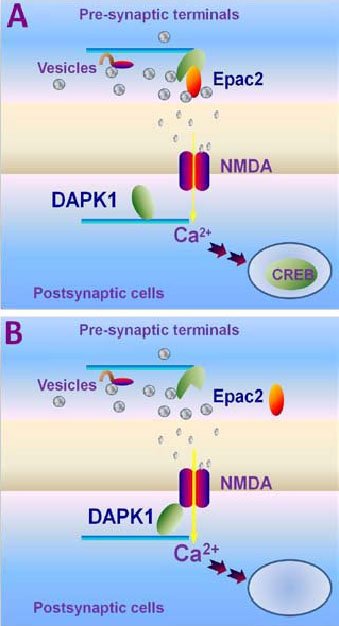
Cell death signals induce the aberrant
changes of synaptic transmission
(A) Under the physiological conditions, excitatory neurotransmitter glutamate releases from the pre-synaptic terminals through synaptic vesicle fusion events, in which Epac, exchange factor that directly activated by cAMP, is involved. Released glutamate binds to its receptors on the post-synaptic sites. One of the principle glutamate receptors is NMDA receptor. Activation of NMDA receptor allows physiological Ca2+ influx and in turn induces gene expression, neuronal growth, synaptic transmission and plasticity. (B) Research in my laboratory has mainly focused on the aberrant changes of synaptic transmission in brain disorders and injury. One of our research projects is targeting to the pre-synaptic terminals, in which Epac mutation deteriorates glutamate release event. We have recently generated the mutant mice with deficiency in expression of Epac genes. We found that genetic deletion of Epac gene declines excitatory synaptic transmission. The second project is focusing on the post-synaptic glutamate receptors. We have discovered that ischemia recruits DAPK1, death-associated protein kinase 1, into the NMDA receptor complex, and induces toxic Ca2+ influx through the receptor channels. We have thus generated the null mutant mice lacking the DAPK1 gene and found that genetic deletion of DAPK1 protects against brain cells death.
RESEARCH INTERESTS AND GOAL
AWARDS AND RECOGNITION
2000-2006: New Investigator Award by Canada Institute for Health Research
2000-2005: Research Scholar Award by Alberta Heritage Foundation for Medical Research
1999-2001: Senior Research Fellowship by Canada Institute for Health Research
1997-1999: Tenable Merit Scholarship by University of Toronto
1997-1999: Laidlaw First Award by University of Toronto
1998-1999: Siminovitch Outstanding Research Award by University of Toronto.
1998: Joe A. Connolly Memorial Outstanding Research Award by University of Toronto
1996-1999: Doctoral Research Award by Medical Research Council of Canada
1991-1993: Postdoctoral Fellow by Ciba Foundation, Switzerland
I am interested in identifying and characterizing the specific cellular and molecular signaling processes that cause the aberrant changes of synaptic transmission and in applying this knowledge for developing the practical strategies in the treatment of Alzheimer's diseases and stroke.
KEY PAPERS
Kim, D., Frank, C.L., Dobbin, M.M., W. Tu., Peng, L.S., Lee, B-H., Giusti, P., Broodie, N., Mazitschek, R., Lu, Y and Tsai L-H (2008) Deregulation of HDAC1 by p25/cdk5 in neurotoxicity. Neuron 60, 801-817.
Peng, P.L., Zhong, X.F., Tu, W.H., Soundarapandian, M.M., Molner, P., Zhu, D.Y., Liu, S.H., and Lu, Y.M (2006) ADAR2-Dependent RNA Editing of AMPA Receptor Subunit GluR2 Determines Vulnerability of Neurons in Forebrain Ischemia. Neuron 49, 719-733.
Liu, S.H., Lau, L., Wei, J.S., Zhu, D.Y., Zou, S., Sun, H.S., Fu, Y.P., Liu, F and Lu, Y.M (2004) Expression of Ca2+-permeable AMPA Receptor Channels Primes Cell Death in Transient Forebrain Ischemia. Neuron 43, 43-55.
Zhu, D.Y., Lau, L., Liu, S.H,. Wei, J.S and Lu, Y.M (2004) Activation of cAMP response element binding protein (CREB) after focal cerebral ischemia stimulates neurogenesis in the adult dentate gyrus. Proc. Natl. Acad. Sci. USA. 101, 9453-9457.
Wang, J., Liu, S.H., Fu, Y.P., Wang, J.H and Lu, Y.M (2003) Cdk5 activation induces CA1 pyramidal cell death by direct phosphorylating NMDA receptors. Nat. Neurosci. 6, 1039-1047.
Wang, J., Liu, S.H., Tu, W.H., Cochrane, K., Tran, L., Paw, J., Fu, Y.P and Lu, Y.M (2003) Interaction of calcineurin and GABAA receptor- γ2 subunit produces long-term depression at CA1 inhibitory synapses. J. Neurosci. 23, 826-836.
Liu, S.H., Wang, J and Lu, Y.M (2003) Generation of functional inhibitory neurons in the adult hippocampus. J. Neurosci. 23, 732-736.
Zhu, D.Y., Liu, S.H., Sun, S.H and Lu, Y.M (2003) Expression of inducible nitric oxide synthase after focal cerebral ischemia stimulates neurogenesis in the adult animal dentate gyrus. J. Neurosci. 23, 223-229.
Huang, Y.Q., Lu, W.Y., Ali, D.W., Pelkey, K.A., Pitcher, G.M., Lu, Y.M., Aoto, H., Roder, J.C., Sasaki, T., Salter, M.W and MacDonald, J.F (2001) CAK/Pyk2 Kinase Is a Signaling Link for Induction of Long-Term Potentiation in CA1 Hippocampus. Neuron 9, 485-496.
Lu, Y.M., Mansuy, I.M., Kandel, E.R., and Roder, J. (2000). Calcineurin-mediated LTD
of GABAergic inhibition underlies the increased excitability of CA1 neurons associated
with LTP. Neuron 26, 197-205.
Lu, Y.M., Roder, J., Davidow, J., and Salter, M.W. (1998). Src activation in the induction
of long-term potentiation in CA1 hippocampal neurons.
ACTIVE FUNDING
R01 NS051383 (PI: Lu) 03/2006 - 02/2011
NIH/NINDS
ADAR2-dependent RNA editing of AMPA receptor subunit GluR2 in ischemia
R01AG033282 (PI: Lu) 08/2008 - 07/2013
NIH/NIA
DAPK1 regulation of NMDA receptor in ischemic neuronal death