
The Belayev Lab: Stoke & Traumatic Brain Injury Laboratories
Advancing Therapies for Stoke, Traumatic Brain Injury, and Gliobastoma
The Belayev Research Program focuses on developing innovative therapies for some of
the most devastating neurological conditions affecting patients worldwide. Through
translational and basic science research, our laboratory investigates novel neuroprotective
strategies designed to improve recovery after stroke, traumatic brain injury, and
malignant brain tumors.
Research at a Glance
Stroke is the fifth leading cause of death in the USA and a leading cause of adult disability. No medical treatment is approved for stroke aside from tissue plasminogen activator (tPA), a thrombolytic agent restricted to administration within 4.5 h after stroke onset, but only a few patients (5–8%) qualify for this treatment within this short window. There is no specific therapy for the majority of stroke patients.
Traumatic brain injury (TBI) is a major cause of death and disability worldwide, especially among children and young adults. Causes include falls, vehicle accidents, and violence. Each year, TBI contributes to a substantial number of deaths and cases of permanent disability. Recent data indicate that approximately 1.7 million people sustain a traumatic brain injury annually. TBI can cause a wide range of short- or long-term functional changes, affecting thinking, sensation, language, and/or emotions. TBI can also cause epilepsy and increase the risk of conditions such as Alzheimer’s disease, Parkinson’s disease, and other brain disorders that become more prevalent with age. There are no approved therapies that directly address these underlying processes.
Glioblastoma multiforme (GBM) is an aggressive, highly proliferative, invasive brain tumor with a poor prognosis and low survival rate. The current standard of care for GBM is chemotherapy combined with radiation after surgical intervention, but efficacy remains limited, with survival averaging 18 months. Improving treatment outcomes for patients with GBM requires a multifaceted approach because of the dysregulation of numerous signaling pathways. Recently emerging therapies that precisely modulate tumor angiogenesis, inflammation, and oxidative stress are gaining attention as potential options to combat GBM.
Featured Research Programs
Elovanoids (ELVs)
Elovanoids are naturally occurring lipid mediators derived from omega-3 fatty acids. Our studies have demonstrated significant neuroprotective effects following stroke, traumatic brain injury, and neurodegenerative disease models.
Docosanoids
Docosanoids are a family of bioactive lipid mediators derived from DHA (docosahexaenoic acid). They possess neuroprotective and pro-homeostatic properties and play an important role in resolving inflammation and promoting tissue repair.
These mediators work by:
- Limiting neutrophil recruitment
- Promoting macrophage clearance of cellular debris
- Counter-regulating pro-inflammatory mediators
- Supporting tissue healing and recovery
Docosanoids belong to a broader class of pro-resolving lipids and are grouped into three major families:
- Protectins
- Resolvins
- Maresins
LAU-0901
LAU-0901 is a novel platelet-activating factor antagonist developed through an international collaboration with the University of Alcala, Spain. Preclinical studies have demonstrated significant neuroprotective effects in experimental models of stroke and Glioblastoma Multiforme (GBM).
From Discovery to Patient Impact
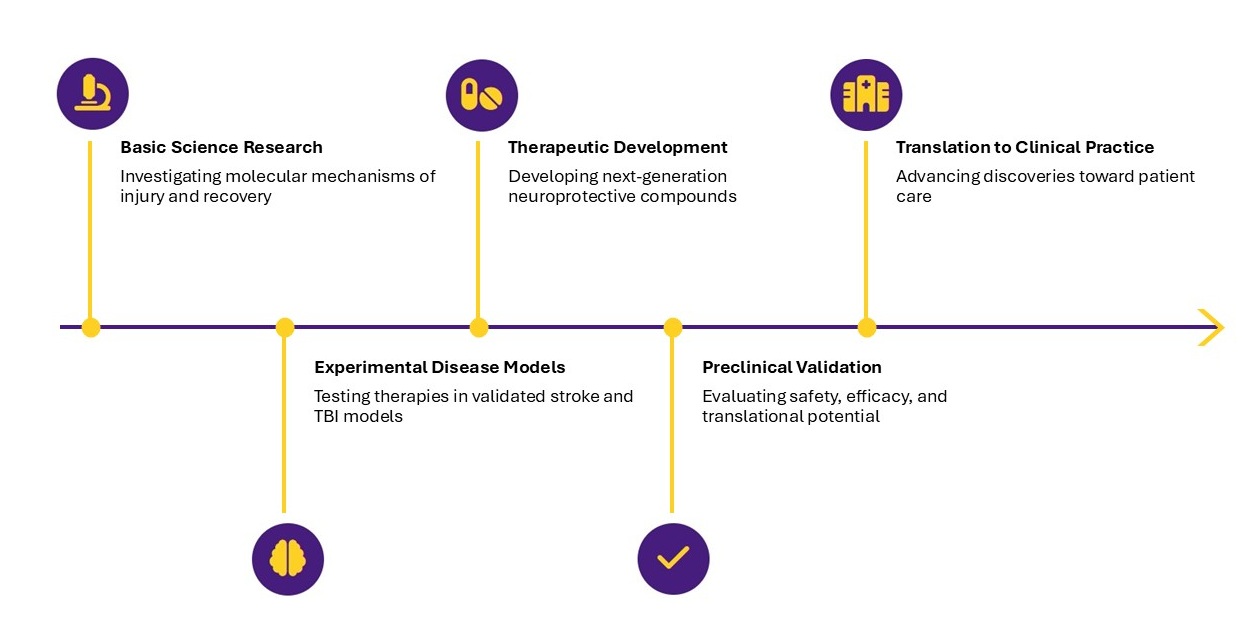
Our laboratory combines both fundamental and translational scientific approaches to accelerate the development of potential therapies and improve patient outcomes.
Research Interests
1. Development and evaluation of animal models of stroke:
- Models of global cerebral ischemia in rats and mice:
- Two-vessel occlusion model of forebrain ischemia
- Four-vessel occlusion model of forebrain ischemia
- Models of focal cerebral ischemia in rats and mice:
- Middle cerebral artery occlusion by intraluminal suture
- Mechanical (electrocoagulation, micro clip)
- Hemorrhagic models in rats and mice:
- Intracerebral hemorrhagic models (blood, collagenase)
- SAH and vasospasm: (injection of blood into the cisterna magna and puncture of the cerebral artery
2. Development and evaluation of animal models of traumatic brain injury:
- Lateral fluid percussion injury model
- Controlled weight drops brain injury
3. Development and evaluation of animal models of spinal cord injury
4. Development and evaluation of animal models of brain tumors
5. Recovering function after brain injury (neural plasticity and reorganization), expertise in different neurobehavioral tests.
6. Evaluation of blood-brain integrity.
7. Histopathology and image analysis of the brain after stroke and head trauma.
8. Neuroprotection in brain ischemia and traumatic brain injury.
Contact Information
Ludmila Belayev, MD
Professor of Neurosurgery, Neurology, and Neuroscience
Phone: 504-599-0849
Fax: 504-599-0488
E-mail: lbelay@lsuhsc.edu
Office Location
Louisiana State University Health Sciences Center
School of Medicine
Neuroscience Center of Excellence
2020 Gravier Str, Suite D, Room 935A
New Orleans, LA 70112