
2025-2026 Guide to Resident Rotations
Overview
The LSU Orthopaedic Surgery Residency emphasizes early operative autonomy with a structured model of graduated responsibility that progresses throughout training. Residents begin developing operative independence early, and as early as the PGY-2 year may function as primary surgeon on appropriate cases with senior resident and faculty supervision, consistent with ACGME requirements for patient safety and education. This approach fosters technical skill development, clinical judgment, and confidence. Graduates of the program consistently report feeling well prepared to manage a broad range of orthopaedic conditions and to transition successfully into fellowship training or independent practice.
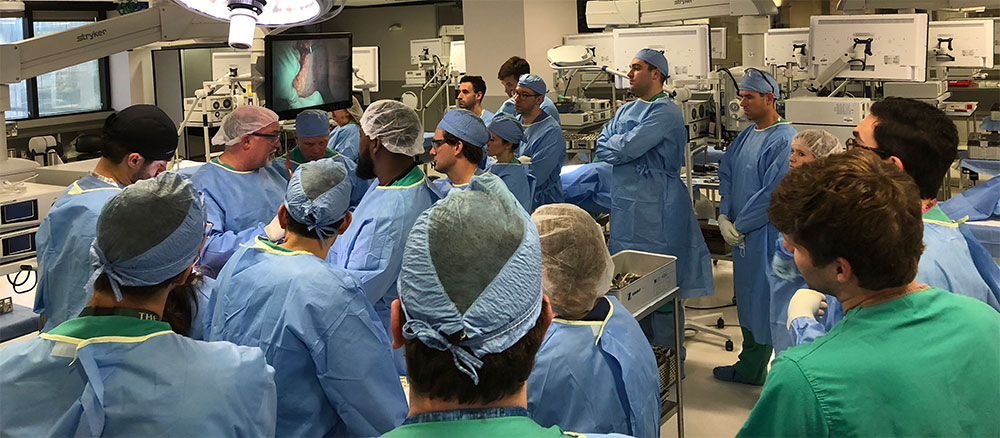
Didactic education is an integral component of the curriculum. Residents actively contribute to and participate in weekly and monthly didactic sessions designed to reinforce core orthopaedic knowledge and evidence-based practice. Monthly Grand Rounds feature guest lecturers and are attended by both residents and faculty, promoting a collaborative academic environment. A key strength of the didactic program is the monthly cadaver laboratory series, which is frequently led by nationally and internationally recognized surgeons and provides hands-on experience with both foundational techniques and advanced procedures.
Our program provides extensive exposure to penetrating trauma and the orthopaedic injuries associated with high-energy mechanisms. Residents are expected to demonstrate progressive mastery in the evaluation, diagnosis, and management of these injuries in accordance with ACGME core competencies. Graduated responsibility is a central feature of our training model; residents run inpatient services and continuity clinics with appropriate faculty supervision, fostering autonomy, clinical decision-making, and accountability. Residents are held to high expectations and consistently demonstrate comfort managing complex trauma cases, including polytrauma patients and long bone fractures, as well as fundamental fracture patterns commonly encountered in community orthopaedic practice.
The curriculum offers a well-rounded education with comprehensive exposure to all orthopaedic subspecialties. Residents benefit from training at a Level I trauma center, a dedicated children’s hospital, and with an orthopaedic oncologist, all located within the same city under the LSU umbrella. This integrated structure provides continuity of education and breadth of pathology that is uncommon among orthopaedic training programs.
Operative volume is a significant strength of the program. Residents participate in a high number of surgical cases early and throughout training, allowing for the development of technical proficiency and confidence. In addition to university-based training, residents spend a substantial portion of their education at a high-volume private practice in Baton Rouge, Louisiana, and at a high-volume community hospital in Lafayette, Louisiana. These rotations provide additional operative autonomy and exposure to efficient, real-world orthopaedic practice across all subspecialties.
Across training sites, residents gain extensive clinical and operative experience managing a wide spectrum of pathology, ranging from common orthopaedic conditions to rare and complex cases. Early and frequent operative involvement, combined with progressive autonomy, ensures that graduating residents are well prepared to pursue fellowship training or enter independent general orthopaedic practice.
The program is committed to resident education and professional development. All residents receive an annual stipend of several hundred dollars for orthopaedic educational resources, which may be used at their discretion. Through the generosity of program alumni, all incoming residents are provided with personalized lead and loupes. Additional institutional funding is available during each year of training to support travel to approved educational courses and conferences, in alignment with ACGME educational goals.
Interested in what our residents have to say about the rotations? click here
PGY-1
University Medical Center (New Orleans, LA)
Orthopaedic Trauma (3 months)
- High-volume Level I trauma center with significant penetrating trauma
- Responsible for daytime floor coverage and consult management (7A–7P)
- Early, high-volume hands-on operative experience
- Extensive exposure to fracture reduction, fracture management, and polytrauma care
- Broad exposure including trauma, foot and ankle, sports medicine, spine, deformity, MIS, and oncology
Musculoskeletal Radiology (1 month)
- Attending-directed experience in interpretation of MSK imaging
- Dedicated MRI reading experience
General Surgery Trauma (1 month)
- Rotation at a high-volume Level I trauma center
- Management of polytrauma patients with combined visceral and orthopaedic injuries
- 24-hour trauma team call
- Participation in trauma activations alongside ED and trauma surgery team
Trauma Intensive Care Unit (1 month)
- Management and triage of critically ill polytrauma patients
- Call with trauma chief and PGY-2 resident
- Hands-on experience with procedures including central line placement and chest tube management
Manning Family Children’s Hospital (New Orleans, LA)
Pediatric Orthopaedics (6 weeks)
- Rotation with faculty specializing in pediatric orthopaedics, orthopaedic oncology, and scoliosis
- Unique, hands-on operative experience for interns
- Extensive experience in fracture reduction, splinting, and casting
- Daily fracture conference reviewing operative cases and ED consults
- Monthly Grand Rounds and journal club participation
- Call shared with Chief Resident (PGY-4)
- Robust research opportunities with pediatric faculty
Veterans Affairs Medical Center (New Orleans, LA)
General Orthopaedics (6 weeks)
- Rotation with faculty focusing on core general orthopaedic pathology
Physical Medicine & Rehabilitation (1 month)
- Introduction to rehabilitation principles as they relate to orthopaedic patients
- No overnight call
Vascular Surgery (1 month)
- Introduction to vascular surgical principles
- Clinical and operative exposure to vascular patients
West Jefferson Medical Center (Marrero, LA)
Neurosurgery/Spine (1 month)
- High-volume private practice neurosurgery rotation
- Operative-focused spine experience; minimal clinic
- No call responsibilities
PGY-2
University Medical Center (New Orleans, LA)
Orthopaedic Trauma (21-22 weeks)
- Two clinic days and two operative days per week
- High-volume experience with femoral and tibial nailing, ankle fractures, periarticular fractures, pelvis/acetabulum, and upper extremity trauma
- Extensive management of gunshot wounds and orthopaedic polytrauma
- Shared call with another PGY-2 resident; alternating hand and spine call
- Daily responsibility for floor management and multidisciplinary coordination
- Dedicated PA-C support for floor care and discharge planning
Manning Family Children’s Hospital (New Orleans, LA)
Pediatric Orthopaedics (10-11 weeks)
- Shared call pool with PGY-2 to PGY-4 residents
- High-volume fracture care and pediatric surgical exposure, including scoliosis and oncology
- Progressive leadership role supervising interns
- Rotations structured in two-week blocks with individual faculty
Baton Rouge Orthopaedic Clinic (Baton Rouge, LA)
Sports Medicine (10-11 weeks)
- Comprehensive training in sports-related evaluation, imaging interpretation, and operative management
- Extensive shoulder and knee arthroscopy experience; optional hip arthroscopy exposure
- Significant operative autonomy in "bread-and-butter" cases
- Opportunity to work with LSU football team physicians and cover high school athletics
- Participation in Baton Rouge-based journal club with alumni involvement
Orthopaedic Spine (10–11 weeks)
- Training in spine evaluation, diagnosis, and operative management
- High-volume experience with significant resident autonomy
PGY-3
Ochsner Medical Center (Kenner, LA)
Adult Reconstruction (3 months)
- Work with three adult reconstruction specialists
- 2–3 OR days and 2 clinic days per week
- Experience in primary and revision hip and knee arthroplasty
- Preoperative templating and surgical planning emphasized
- Community hospital call (approximately 5 days/month)
Ochsner University Hospital & Clinics (Lafayette, LA)
General Orthopaedics (3 months)
- Resident-run clinic with dedicated nursing support
- High degree of operative autonomy with faculty supervision
- Residents select implants and vendors for cases
- No ER call and no weekends
- Weekly videoconference with New Orleans academic conferences
Hand Center of Louisiana (Metairie, LA)
Hand Surgery (3 months)
- 2–3 operative days and 2 clinic days per week
- Experience in both acute traumatic hand injuries and chronic conditions
- Significant operative autonomy and responsibility for preoperative planning
- Limited trauma call (2 days/month); no weekend responsibilities
Baton Rouge Orthopaedic Clinic (Baton Rouge, LA)
Adult Reconstruction (3 months)
- Independent work with high-volume hip and knee arthroplasty surgeon
PGY-4
University Medical Center (New Orleans, LA)
Orthopaedic Trauma (3 months)
- Upper-level resident leadership role
- Supervision and teaching of junior residents
- Responsibility for operative planning, implant selection, and OR workflow
- Coordination of weekly trauma education and journal discussions
Orthopaedic Oncology (3 months)
- Tertiary referral center exposure
- Multidisciplinary collaboration with pathology, MSK radiology, radiation and surgical oncology
- Comprehensive tumor workup and management experience
Manning Family Children’s Hospital (New Orleans, LA)
Pediatric Orthopaedics (3 months)
- Supervision and mentorship of junior residents
- Increased operative autonomy based on demonstrated skill
- Focus on preparing interns for independent call
Baton Rouge Orthopaedic Clinic (Baton Rouge, LA)
Foot & Ankle (3 months)
- High-volume private practice experience
- Broad exposure to clinical and operative foot and ankle pathology
- Insight into private practice workflow and management
PGY-5
University Medical Center (New Orleans, LA)
Orthopaedic Trauma (3 months)
- Leadership of the trauma service
- Coordination of OR schedules, call coverage, and implant logistics
- Teaching junior residents while managing complex trauma cases with increased autonomy
Baton Rouge Orthopaedic Clinic (Baton Rouge, LA)
General Orthopaedics Chief (3 months)
- Independent general orthopaedic clinic and operative practice
- Tailored operative experience based on career goals
- No new consult ER call; LSU service only
Ochsner University Hospital & Clinics (Lafayette, LA)
General Orthopaedics (3 months)
- Senior leadership role with full service responsibility
Ochsner Medical Center (Kenner, LA)
Sports Medicine (3 months)
- Advanced shoulder and knee surgery with the Residency Director
- Continued arthroplasty exposure
- Community hospital ER home call (approximately 5 days/month)